Madison Investment and Insurance Committee – Economic Update 9 September 2020
By Andrea Theouli
In Australia, the economy is going through a difficult period, experiencing the biggest contraction since the 1930s[1]. The downturn is not as severe as earlier expected and a recovery is underway across most of Australia. The recovery is, however, likely to be uneven and bumpy. Not surprisingly, the more recent resurgence of COVID-19 has dulled confidence and spending. Consumer confidence in Australia had slipped in July and August as the second wave took off in Victoria. However, by the end of August, sentiment had turned more positive similar to levels seen in late June.
Globally, an uneven economic recovery is underway after a severe contraction in the first half of 2020. The future path of economic recovery is greatly dependent on the containment of the virus. August saw restrictions maintained in many countries to contain second waves of COVID-19. Progress in reducing infection rates was made in the US, but there is still a long way to go before the virus is under control. Europe is in the grip of a significant second wave. The most affected countries include Spain and France, both of which now have infection rates exceeding those in their first waves. By contrast, in China, economic growth has been relatively strong.
Key developments in August 2020
One of the most important developments in August was the long-awaited speech by U.S. Federal Reserve (Fed) Chairman Jerome Powell. Powell announced the results of the Fed’s Review of Monetary Policy Strategy, Tools and Communications. This was prompted by the Fed’s failure to meet its 2% inflation target over several years, as well as the fact that when the unemployment rate fell to 50-year lows in 2019[2], inflation did not pick up as expected.
The essence of the changes announced by Powell was that the Fed is prepared to see the unemployment rate fall a long way and not worry if inflation rises above 2% in the process[3]. That is, they will be slower to raise interest rates than they have been in the past. The Fed has become more concerned about the social aspects of unemployment, especially how it impacts more vulnerable sections of society.
The markets
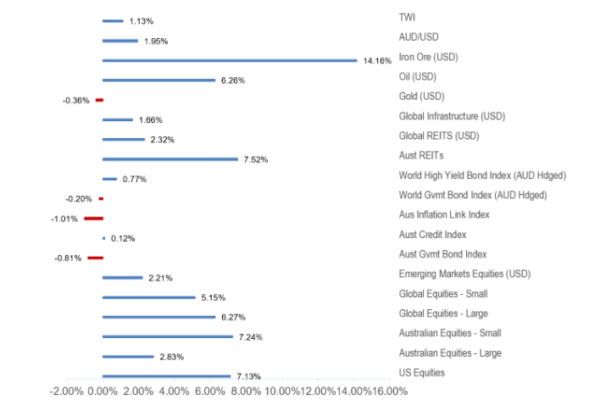
The US equity market powered on in August (see chart 1), led once more by tech stocks. As an example of the rapid rise of tech stocks this year in the U.S., Apple Inc. is the first company to be valued at more than $2 trillion. Except for a few weeks at the end of 2007, Apple Inc has never traded at a stronger multiple of future earnings.
The Australian market had a more subdued month, although AREITs outperformed to make up some of the ground lost to the rest of the market in recent months. The news on interest rates and unemployment in the U.S. helped push the U.S. dollar down further. This, plus a further solid rise in the iron ore price, helped drive the A$/U.S.$ up from U.S.$0.721 at the end of July to U.S.$0.735 by the end of August.
Eurozone consumer prices fell by 0.4% in August, confirming the deflationary environment, with core consumer prices a very low 0.4% over the year. Eurozone retail sales showed some moderation and fell by 1.3% in July, after a huge surge in the post-lockdown months. Despite some rise in COVID-19 cases again in Europe, third-quarter Eurozone GDP is expected to be very strong, at over 7% over the quarter.
Japan’s industrial production jumped by 8% in July, with demand for autos surging. But retail sales fell by 3.3% in July.
A trend between the COVID-19 infection rate and the price of Gold has emerged. Higher rates of infection seem to drive higher demand for gold as a safe-haven asset. The decline in COVID-19 infections in the US has seen gold slip back to around U.S.$1968/oz by the end of August after previously topping the U.S.$2,000/oz mark.
Oil broke down to a 2-month low and out of the recent tight trading range as it becomes increasingly apparent that oil demand will continue to lag any economic recovery, particularly while the airline industry remains dormant.
Chart 1 – Equities rallied further in August and higher iron ore prices pushed the A$ up
Sources: Thomson Reuters, Bloomberg (equity returns are total return)
Segments of the equity market continue to remain expensive with inherently elevated levels of risk. The ongoing impact of COVID-19 on earnings into the future remains unclear. Diversification of assets remains paramount particularly given the high level of uncertainty in the market from factors including:
- COVID-19
- The US election
- Geopolitical tensions and
- The impact of continued fiscal and monetary support.
What now?
When history books one day recount the COVID-19 pandemic, it may well be a tale of human inventiveness and adaptiveness. Although COVID-19 has infected significantly more than 24 million people[4] and left hundreds of thousands of people dead, the early projections of mortality were much worse.
Maintaining resilience during times of upheaval is difficult. We have identified four stages that outline the path through the recovery:
- Reaction – everyone globally has been impacted both professionally and personally. Volatility and uncertainty has permeated through society as we focus is on limiting damage to our lives and livelihoods as we weather the COVID-19 storm.
When markets fluctuate, the human response is to act: ”buy more or sell”. While it can be difficult to overcome the gut reaction to act quickly, remember to take a step back and understand the factors influencing the downturn before making any decisions.
- Resilience – controls will loosen as virus spread is contained and/or a vaccination or cure is available. Consumer demand has already begun to return but is hampered by lost wages, investment losses, and recession fears.
It is important to consider whether investment portfolios remain relevant to goals and objectives.
- Recovery – anxiety will pass and hiring, investment and consumer sentiment will improve (albeit cautiously). Recovery paths for individuals and organisations will vary based on the ability to limit damage from the Reaction stage.
The length and severity of the recession will also play a part and will willingness to adapt to new conditions. This could include reducing expectations inline with the subdued returns expected over the coming years.
- Fresh Reality – a number of continuing shifts will remain post-recovery as many of the adapted behaviours born out of the pandemic become central to the overarching, evolving environment. Managing through the current challenges, and embedding resilience for recovery and the new reality will be challenging, perseverance and patience will be key particularly in the short-term.
[1] Statement by Philip Lowe, Governor: Monetary Policy Decision 1 September 2020
[2] U.S. Umeployment rate falls to 50 year low – https://www.whitehouse.gov/articles/u-s-unemployment-rate-falls-50-year-low/
[3] Review of Monetray Policy Strategy, Tools and Communications 2019-2020: overview
[4] https://www.news.com.au/lifestyle/health/health-problems/modelling-shows-us-likely-has-24-million-cases-of-coronavirus-according-to-cdc-director/news-story/2c8024c5b62a6b64ae3e51d41ea59c4f
Madison Investment and Insurance Committee – Economic Update 9 September 2020
By Andrea Theouli
In Australia, the economy is going through a difficult period, experiencing the biggest contraction since the 1930s[1]. The downturn is not as severe as earlier expected and a recovery is underway across most of Australia. The recovery is, however, likely to be uneven and bumpy. Not surprisingly, the more recent resurgence of COVID-19 has dulled confidence and spending. Consumer confidence in Australia had slipped in July and August as the second wave took off in Victoria. However, by the end of August, sentiment had turned more positive similar to levels seen in late June.
Globally, an uneven economic recovery is underway after a severe contraction in the first half of 2020. The future path of economic recovery is greatly dependent on the containment of the virus. August saw restrictions maintained in many countries to contain second waves of COVID-19. Progress in reducing infection rates was made in the US, but there is still a long way to go before the virus is under control. Europe is in the grip of a significant second wave. The most affected countries include Spain and France, both of which now have infection rates exceeding those in their first waves. By contrast, in China, economic growth has been relatively strong.
Key developments in August 2020
One of the most important developments in August was the long-awaited speech by U.S. Federal Reserve (Fed) Chairman Jerome Powell. Powell announced the results of the Fed’s Review of Monetary Policy Strategy, Tools and Communications. This was prompted by the Fed’s failure to meet its 2% inflation target over several years, as well as the fact that when the unemployment rate fell to 50-year lows in 2019[2], inflation did not pick up as expected.
The essence of the changes announced by Powell was that the Fed is prepared to see the unemployment rate fall a long way and not worry if inflation rises above 2% in the process[3]. That is, they will be slower to raise interest rates than they have been in the past. The Fed has become more concerned about the social aspects of unemployment, especially how it impacts more vulnerable sections of society.
The markets
The US equity market powered on in August (see chart 1), led once more by tech stocks. As an example of the rapid rise of tech stocks this year in the U.S., Apple Inc. is the first company to be valued at more than $2 trillion. Except for a few weeks at the end of 2007, Apple Inc has never traded at a stronger multiple of future earnings.
The Australian market had a more subdued month, although AREITs outperformed to make up some of the ground lost to the rest of the market in recent months. The news on interest rates and unemployment in the U.S. helped push the U.S. dollar down further. This, plus a further solid rise in the iron ore price, helped drive the A$/U.S.$ up from U.S.$0.721 at the end of July to U.S.$0.735 by the end of August.
Eurozone consumer prices fell by 0.4% in August, confirming the deflationary environment, with core consumer prices a very low 0.4% over the year. Eurozone retail sales showed some moderation and fell by 1.3% in July, after a huge surge in the post-lockdown months. Despite some rise in COVID-19 cases again in Europe, third-quarter Eurozone GDP is expected to be very strong, at over 7% over the quarter.
Japan’s industrial production jumped by 8% in July, with demand for autos surging. But retail sales fell by 3.3% in July.
A trend between the COVID-19 infection rate and the price of Gold has emerged. Higher rates of infection seem to drive higher demand for gold as a safe-haven asset. The decline in COVID-19 infections in the US has seen gold slip back to around U.S.$1968/oz by the end of August after previously topping the U.S.$2,000/oz mark.
Oil broke down to a 2-month low and out of the recent tight trading range as it becomes increasingly apparent that oil demand will continue to lag any economic recovery, particularly while the airline industry remains dormant.
Chart 1 – Equities rallied further in August and higher iron ore prices pushed the A$ up
Sources: Thomson Reuters, Bloomberg (equity returns are total return)
Segments of the equity market continue to remain expensive with inherently elevated levels of risk. The ongoing impact of COVID-19 on earnings into the future remains unclear. Diversification of assets remains paramount particularly given the high level of uncertainty in the market from factors including:
- COVID-19
- The US election
- Geopolitical tensions and
- The impact of continued fiscal and monetary support.
What now?
When history books one day recount the COVID-19 pandemic, it may well be a tale of human inventiveness and adaptiveness. Although COVID-19 has infected significantly more than 24 million people[4] and left hundreds of thousands of people dead, the early projections of mortality were much worse.
Maintaining resilience during times of upheaval is difficult. We have identified four stages that outline the path through the recovery:
- Reaction – everyone globally has been impacted both professionally and personally. Volatility and uncertainty has permeated through society as we focus is on limiting damage to our lives and livelihoods as we weather the COVID-19 storm.
When markets fluctuate, the human response is to act: ”buy more or sell”. While it can be difficult to overcome the gut reaction to act quickly, remember to take a step back and understand the factors influencing the downturn before making any decisions.
- Resilience – controls will loosen as virus spread is contained and/or a vaccination or cure is available. Consumer demand has already begun to return but is hampered by lost wages, investment losses, and recession fears.
It is important to consider whether investment portfolios remain relevant to goals and objectives.
- Recovery – anxiety will pass and hiring, investment and consumer sentiment will improve (albeit cautiously). Recovery paths for individuals and organisations will vary based on the ability to limit damage from the Reaction stage.
The length and severity of the recession will also play a part and will willingness to adapt to new conditions. This could include reducing expectations inline with the subdued returns expected over the coming years.
- Fresh Reality – a number of continuing shifts will remain post-recovery as many of the adapted behaviours born out of the pandemic become central to the overarching, evolving environment. Managing through the current challenges, and embedding resilience for recovery and the new reality will be challenging, perseverance and patience will be key particularly in the short-term.
[1] Statement by Philip Lowe, Governor: Monetary Policy Decision 1 September 2020
[2] U.S. Umeployment rate falls to 50 year low – https://www.whitehouse.gov/articles/u-s-unemployment-rate-falls-50-year-low/
[3] Review of Monetray Policy Strategy, Tools and Communications 2019-2020: overview
[4] https://www.news.com.au/lifestyle/health/health-problems/modelling-shows-us-likely-has-24-million-cases-of-coronavirus-according-to-cdc-director/news-story/2c8024c5b62a6b64ae3e51d41ea59c4f